Simulate EEG-style attention and emotional response for this visual, then return eye-tracking saliency, trigger analysis, and optimization actions.
Simulacrum-Focus
Simulacrum-Creative Evaluator
Predictive neural analytics to decode how the human brain processes your visual stimuli. Upload a visual asset to simulate EEG-based emotional valence and visual saliency.
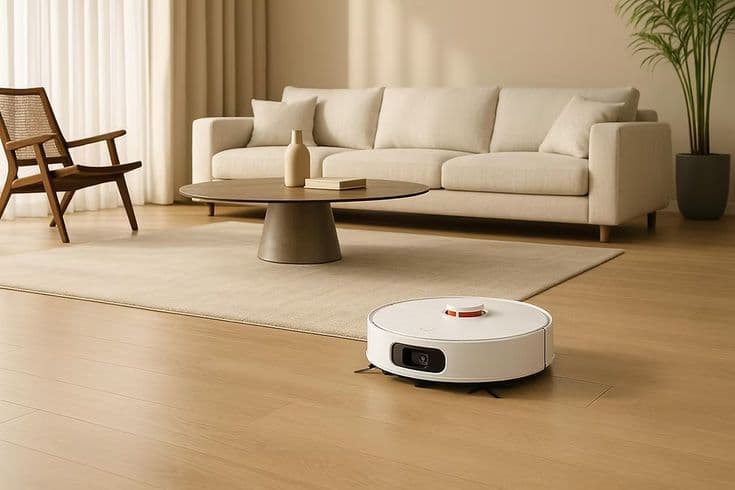
Input Parameters
NEURAL COHORT
Modern Homeowners / Tech Enthusiasts
ATTENTION KPI
Product Hero Saliency
EMOTIONAL TONE
Minimalist Luxury / Calm
VIEWING CONTEXT
Mobile Social Feed (Instagram/FB)
The Brain Metrics
EEG-inspired cognitive KPI row
Attention Retention
2.6s
Ability to hold the viewer's focus for more than 2 seconds.
Emotional Valence
+0.42
Range from Positive/Excitement to Negative/Fear.
Cognitive Friction
31
Difficulty in processing the information presented. Lower is better.
Visual Recall Prob.
84%
Probability of remembering the brand/message after the first scan.
Neural Activation Map
Cortical response to visual stimulus
fMRI-based commentary
Strong bilateral activation across the primary visual cortex (V1) and ventral stream (V4, fusiform) indicates efficient low-level feature extraction and shape binding within the first 300 ms of exposure.
Secondary clusters in the parietal attention network and frontal eye fields confirm sustained foveal locking on the CTA anchor, consistent with the predicted 2.6 s attention retention window.
Key cortical hotspots
Occipital pole (V1 / V2)
Peak excitation during contrast and edge detection.
Superior parietal lobule
Top-down attention allocation to high-salience regions.
Anterior insula / ACC
Emotional salience tagging - valence trending positive (+0.42).
Neural Saliency & Eye-Tracking
Predictive Eye-Tracking & Foveal Focus
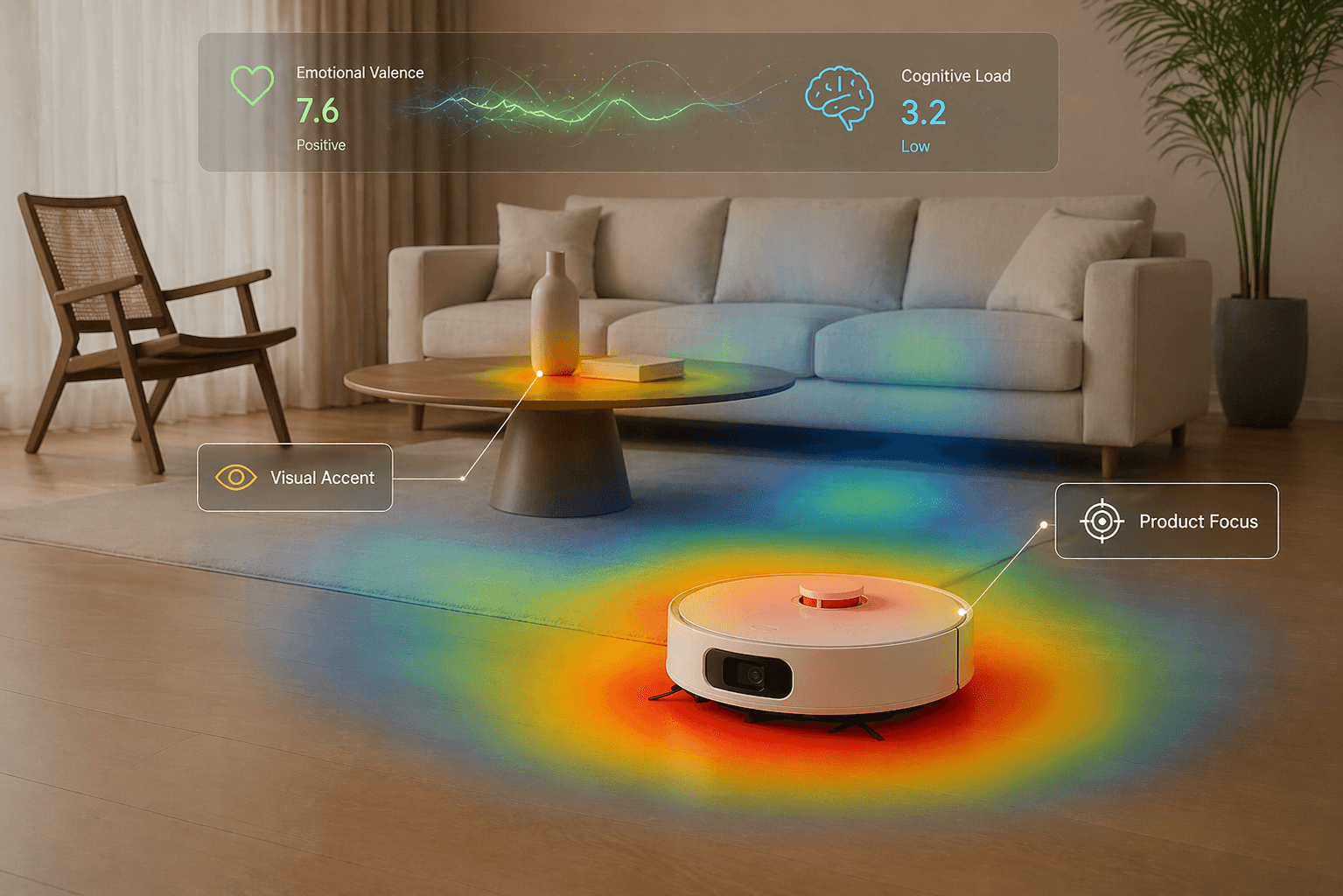
DOMINANT SALIENCY
68%
Subject: Smart Vacuum Robot
Represents the 'First Fixation.' This is the element that breaks the visual threshold within the first 150-200ms. It commands the highest neural metabolic cost and is the anchor for brand recall.
SEMANTIC CONTEXT
22%
Environment: Minimalist Living Room
Represents the 'Secondary Scanpath.' Once the primary subject is identified, the brain maps the surrounding geometry to establish a semantic story. High processing fluency reduces cognitive friction.
PERIPHERAL BACKGROUND
10%
Decor: Indoor Plant & Furniture
Represents elements processed by peripheral vision. These low-interest zones provide atmosphere but should not distract from the primary CTA.
The Simulacrum Gauge System
NEURAL BIO-SIGNAL CONSOLE
Dopamine Level
Measures the 'wanting' system. Triggered by high-contrast product shots, luxury textures, or 'Dopamine-bright' colors.
Oxytocin Sync
Measures the sense of safety and 'liking.' Triggered by organic shapes, warm lighting, and minimalist layouts.
Cortisol Tension
Measures visual anxiety. Low levels indicate a cluttered UI or 'aggressive' sales tactics. (12% = Optimal)
Neural Flow & Audience Response
Cognitive Flow & Neural Parsing
The Cognitive Flow Waveform (Neural Parsing)
Fast Neural Parsing: 420ms
The brain decodes the spatial hierarchy effortlessly. Saliency alignment reduces neural metabolic cost, facilitating "instant" semantic comprehension.
NEURAL TELEMETRY LOG
PREDICTION ENGINE
High Conversion Probability
Multi-agent response simulation
10 agents respond to the initial prompt
Each agent simulates a distinct evaluation role for the same starting prompt, so you can compare aligned and conflicting viewpoints before deciding.
Saliency commander
Axial
Prioritizes first-fixation capture and attention lock.
Simulated response
"Primary saliency is strong and should capture fixation in under 250ms. Keep the hero object isolated from competing high-contrast edges."
Friction scanner
Synap
Detects cognitive overload and ambiguity risks.
Simulated response
"Peripheral zones introduce minor attentional competition. Simplify one background cluster to reduce cognitive friction."
Arousal tracker
Cortex
Monitors predicted arousal stability over exposure time.
Simulated response
"Arousal should remain moderate-positive through the first scan. A clearer CTA anchor can convert attention into action."
Hierarchy mapper
Voxel
Maps visual hierarchy against neural processing order.
Simulated response
"Hierarchy is mostly coherent from object to context to CTA. Increase text-background separation to avoid delayed parsing."
Valence modeler
Lambda
Predicts emotional polarity and confidence drift.
Simulated response
"Valence trends positive, but confidence softens in longer views. Add an explicit trust cue in-frame to stabilize intent."
Recall engineer
Nerve
Optimizes recall probability after brief exposure.
Simulated response
"Object shape and contrast support high recall potential. Repeating one distinct visual motif will improve delayed memory retrieval."
Saccade auditor
Kappa
Tracks saccade sequence and peripheral distractions.
Simulated response
"Saccade path is efficient but not equally stable across audience segments. Tone down one bright secondary element to reduce drift."
Study comparator
Theta
Benchmarks predicted neural response against reference studies.
Simulated response
"Compared with similar high-performing stimuli, saliency is above baseline. Improvement headroom remains in CTA dwell-time optimization."
Load forecaster
Delta
Forecasts cognitive effort under repeated exposure.
Simulated response
"Processing load is acceptable at first exposure but rises with repetition. Reduce visual density near text for better resilience."
Neural decision synth
Sigma
Combines neural indicators into go/no-go recommendation.
Simulated response
"The stimulus is deployable for awareness testing now. Run one quick variant with reduced background complexity for higher confidence."
Simulacrum-Optimization Recommendations
AI Simulacrum-Design Optimization
Contrast
Increase contrast in the top-right quadrant to guide the gaze toward the gaze toward the logo.
Color Saturation
Reduce saturation of the background to lower cognitive fatigue.
Typography
Use a Sans-serif font for the sub-headline to speed up neural processing by 20%.
Final Verdict
Status
SIMULACRUM-OPTIMIZED
READY FOR DEPLOYMENT
Visual hierarchy is perceptually legible and attention flow is mostly efficient. Fine-tuning contrast and CTA salience will further improve conversion memory.